Audio RoomsSovren · Shipped September 2026
The hands were already up.
I was tasked with getting more people speaking in audio rooms. Too few rooms got past one voice. Listeners' hands were already up, buried behind chat where hosts couldn't see them. I redesigned the host's screen and rooms with two or more speakers rose 37%.
Audio rooms launched well, but too few of them got past one speaker.
We launched audio rooms inside our lounges. If you haven't used one, it's a live conversation you can drop into. A host runs it, a few people talk on stage, everyone else listens, and a chat runs alongside. Shrink it to a bar and it keeps playing while you scroll.
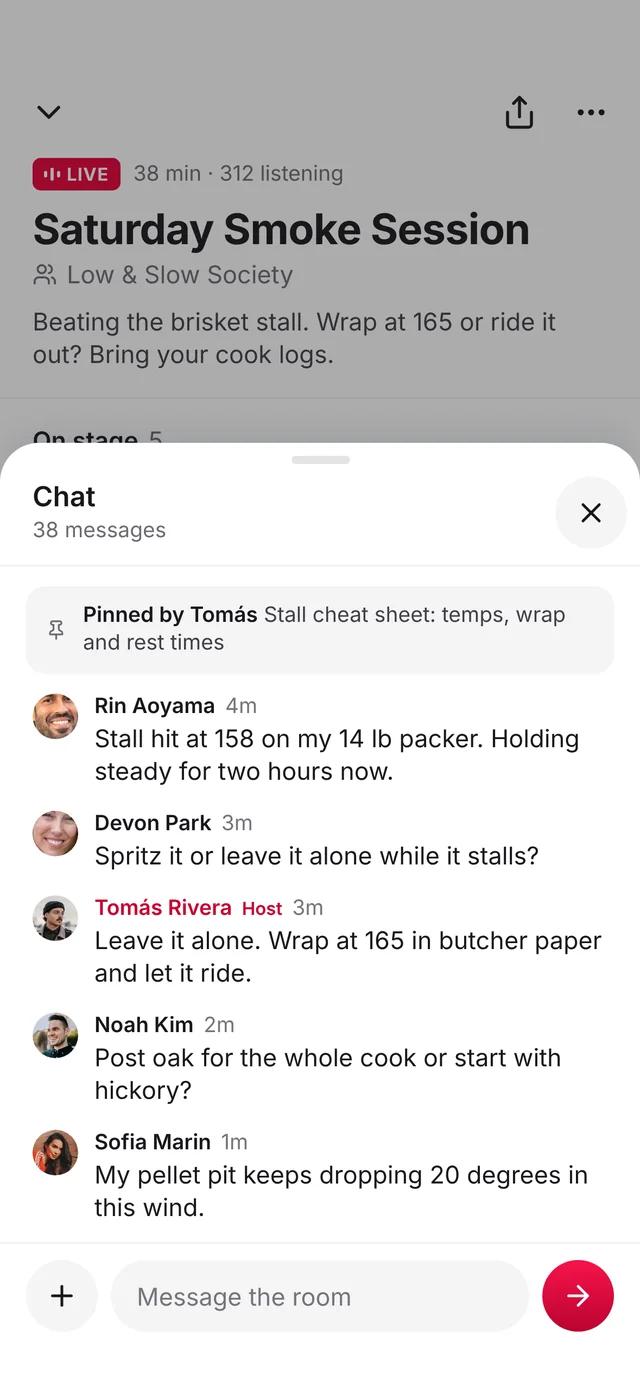
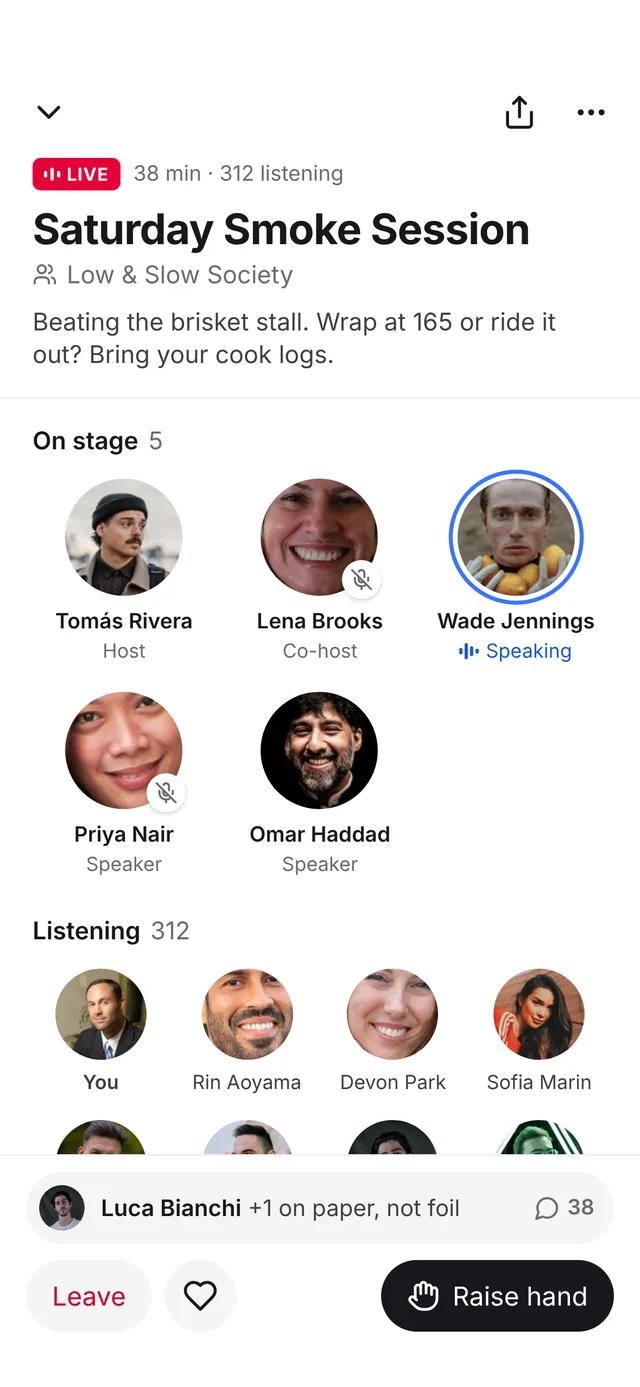

It went well. People showed up and hosts kept scheduling rooms.
The benchmark I cared about was multi-speaker rooms. A room where only the host talks is a podcast with worse audio. The whole reason to build live audio is the moment a listener gets pulled up and the room turns into a conversation. I noticed that number coming in under what we'd set, and I took on fixing it.
We assumed listeners didn't want to talk.
The standard answer is that most listeners are lurkers, so you nudge them. A "want to speak?" prompt, a hint on the raise-hand button, a push when a friend goes on stage. Every audio product has some version of it. It's cheap to build and easy to measure, and it was first on our list.
It only works if listeners are the problem. Before writing that spec, I wanted to see what actually happened in a room.
Two weeks in live rooms, as a listener and as a host, then interviews.
I did three things:
- Watched. I sat in live rooms for two weeks and logged every raised hand: when it went up, whether the host reacted, and how it ended.
- Hosted. I ran rooms myself, talking and reading chat at the same time, to feel what the host's screen asks of you.
- Interviewed. Short, pointed calls with hosts, and with listeners whose hands had gone unanswered.
Each side got one main question. I asked hosts to walk me through the last time someone raised a hand. I asked listeners what they thought happened when nobody called on them. Most hosts couldn't remember a hand at all. Most listeners figured they'd been ignored.
The hands were up. Hosts couldn't see them.
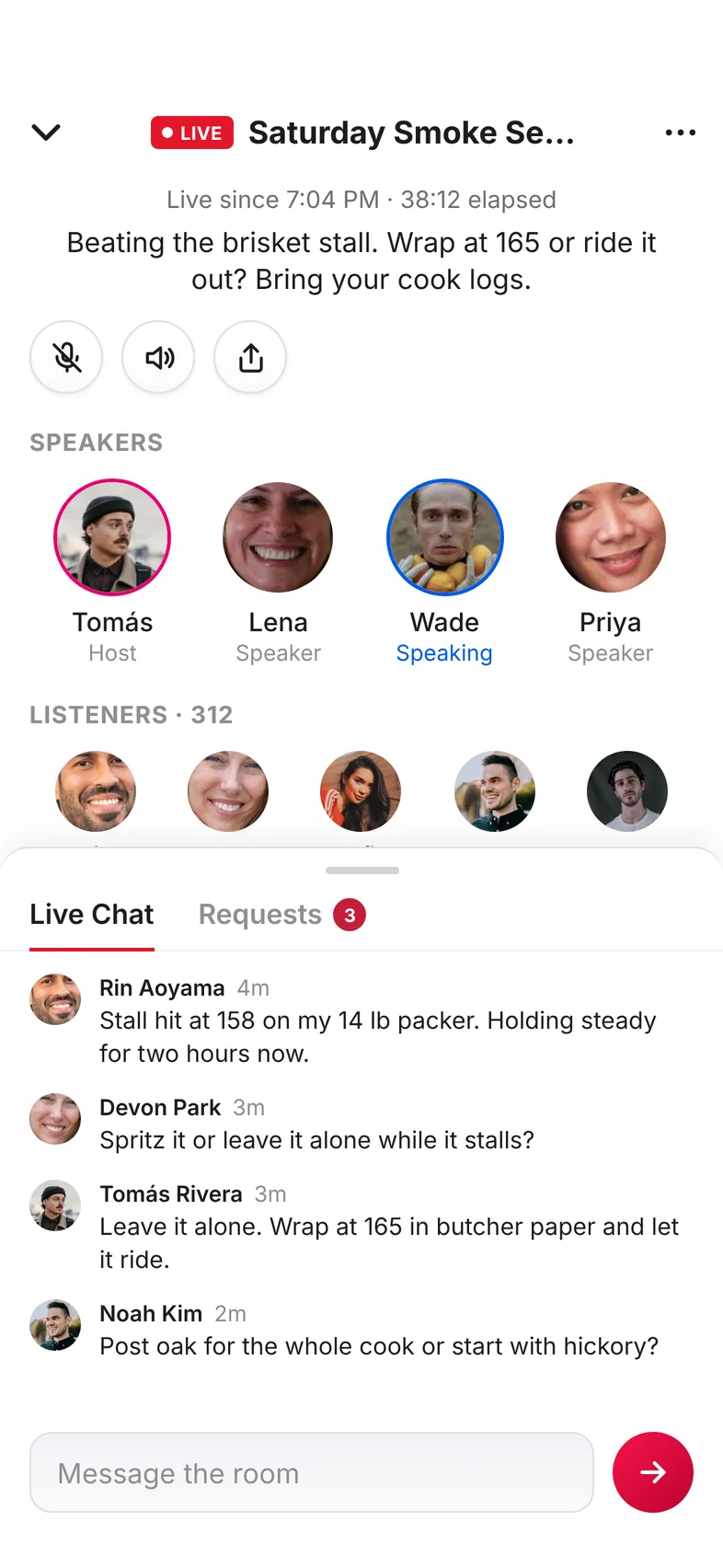
I saw it in the log, and I felt it when I hosted. Raised hands lived on a Requests tab, behind Live Chat. Chat was the default tab and opened to almost half the screen. The only sign a hand had gone up was a small red count on the tab you weren't looking at. Nothing buzzed or popped up when a hand went up.
A host is doing two jobs at once: talking, and reading chat to keep the room moving. Their eyes are on the chat. So a listener raises a hand, waits a minute or two, and puts it down. Most of the listeners I talked to didn't try again.
Listeners were already asking. Nudging them harder would just add hands nobody could see, so the fix went on the host's screen.
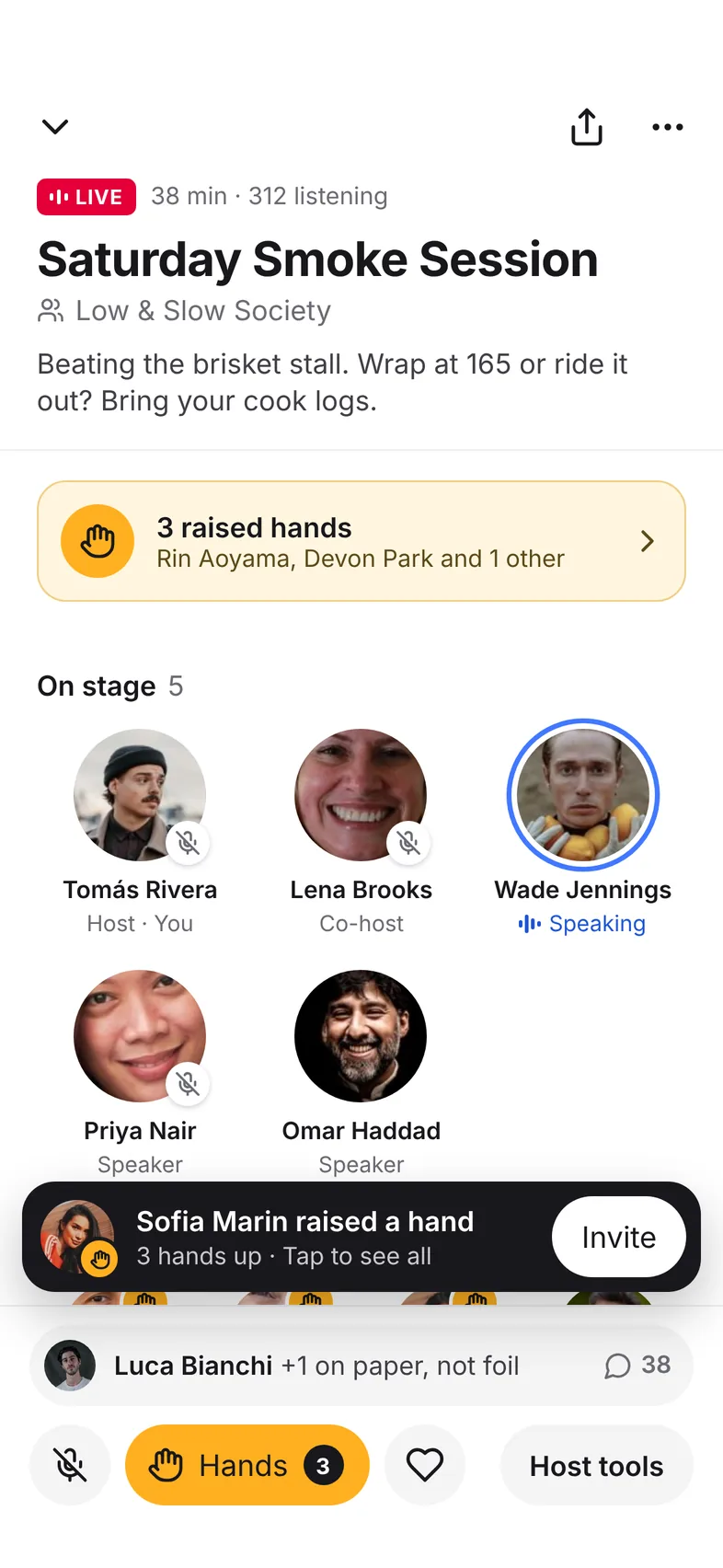
Raised hands now show up where the host is looking, and chat folds down to one line.
I wanted hosts to see every hand without leaving the conversation, so I rebuilt the host's side of the room around that. Same room and same sample cast in both.
 1
2
- 1Hands sit on RequestsA small red count, on a tab the host isn't looking at.
- 2Chat opens by defaultIt takes almost half the screen.
- Nothing alerts the hostNo sound, banner or buzz when a hand goes up.
 1
2
3
4
- 1Hands on the stageEvery raised hand, named, at the top of the room.
- 2A toast by the thumbA new hand pops up with Invite. One tap.
- 3Chat on one lineThe latest message and a count. Tap to open it.
- 4A count on HandsOpens the queue, oldest hand first.
Chat was the change I worried about. It's where a room's energy lives, so collapsing it couldn't feel like losing it. The latest message stays in view with a count beside it, and one tap brings the whole thing back.
One change for the listener on the other end: an invited speaker joins muted, with a mic check in the invite, so nobody gets caught on a hot mic in front of three hundred people.
- Situation
- Hosts needed to see hands, and chat is where a room's energy lives.
- Call
- Give the stage and the hand queue the screen, and collapse chat to one line by default.
- Cost
- Chat gets less room. If people stopped chatting, we'd have traded one kind of participation for another.
Rooms with two or more speakers, with chat as the guardrail.
The metric was the share of live rooms where at least one person besides the host spoke. It's the closest number to what I wanted, which is rooms that turn into conversations. I compared it against the four weeks before the change.
Two numbers sat under it. The share of raised hands that got an answer, which told me whether hosts were seeing them. And chat messages per listener, the guardrail. A bad result would have looked like speakers up and chat down by about the same amount. That would have meant we'd just moved the room from the keyboard to the mic.
Rooms with two or more speakers went up 37%, against a goal of over 15%.
Rooms with two or more speakers rose 37% against the four weeks before, more than clearing our goal of over 15%. More raised hands got an answer, and chat per listener held steady, so the stage grew and the chat kept going. Every change was on the host's side.
I owned the research, the call and the design. Engineering owned the build.
Mine
- Catching that multi-speaker rooms were under benchmark, and taking it on.
- The research: two weeks in live rooms, hosting, and the interviews.
- The call to fix the host's screen before nudging listeners.
- The redesign of the host and listener flows, on mobile and web.
- The success metric and the chat guardrail.
Not mine
- The audio and realtime infrastructure under the rooms.
- Engineering's build of the redesign.
Whether nudging listeners would have added more, and how this holds in big rooms.
I never ran the listener-nudge test, so I can't say it would have done nothing. It might stack on top of this. It's the next test I'd run.
Our rooms are small to mid-sized. In a room of thousands, a banner for every hand becomes noise, and the host needs a filtered queue or a co-host working it.
A before-and-after comparison can carry a novelty bump. I'd want a few more months of data before calling 37% the new normal.
The first number I'd pull somewhere bigger is the share of raised hands answered within a minute, by room size.